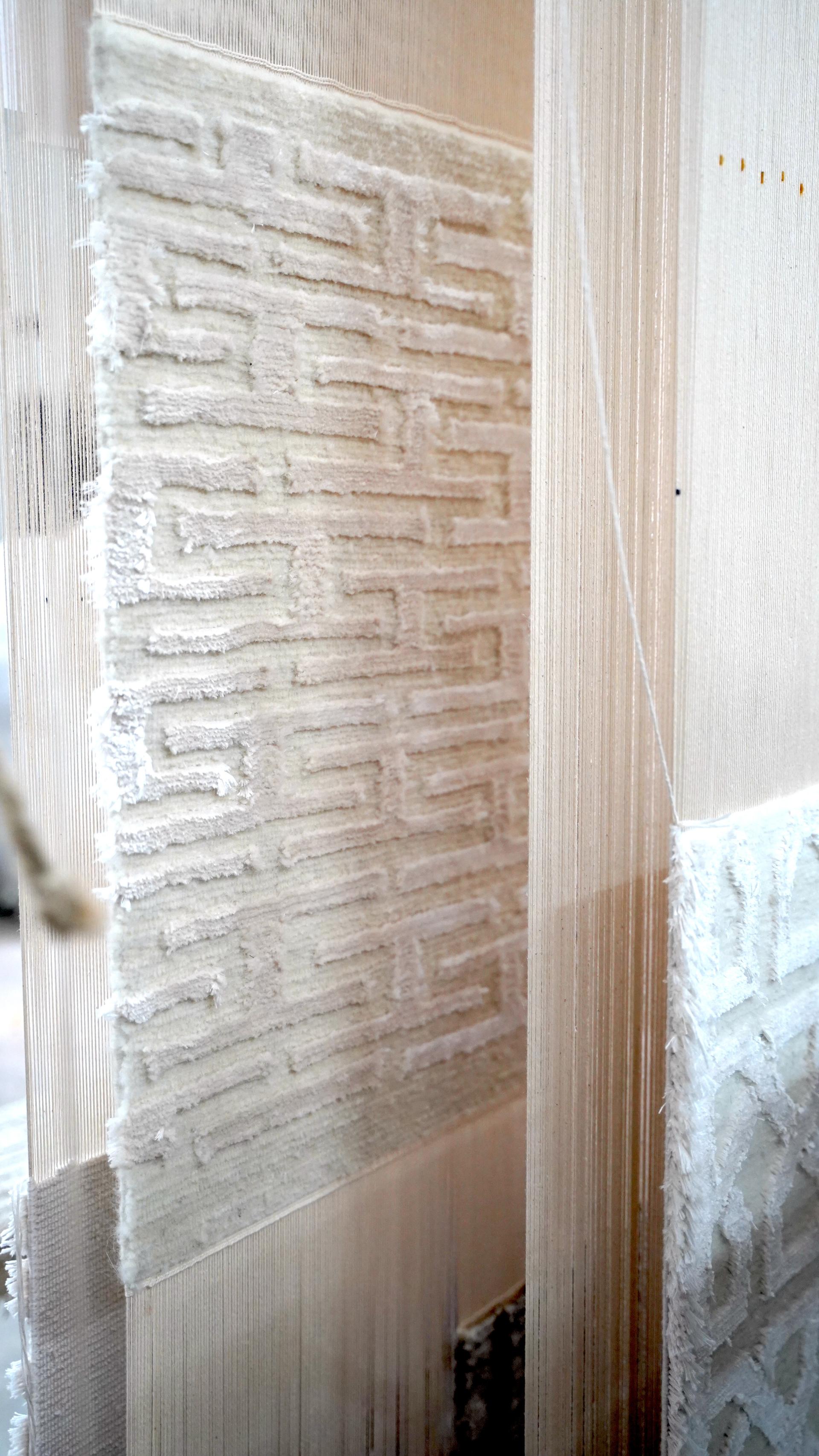
A hotel rug project moves through ten stages: brief, design development, specification and costing, sampling, approval, order and yarn, production, inspection, shipping, and installation with handover. The stages run in a fixed order because each one depends on a decision made in the one before, so the fastest projects are the ones where decisions are made once, in writing, by the right person.
This post sets out what happens at each stage, who usually owns it, and what makes it run longer or shorter. It does not cover what a specification should contain, which our guide to writing a hotel rug specification covers.
The ten stages at a glance
| Stage | What happens | Usually owned by | Output |
|---|---|---|---|
| 1. Brief | Areas, quantities, sizes, budget and dates are set out | Interior designer and procurement | Rug schedule by area |
| 2. Design development | Artwork is drawn or adapted to each size and area | Designer with the manufacturer's design team | Scaled artwork per design |
| 3. Specification and costing | Construction, fibre, pile and finish are fixed and quoted | Manufacturer, reviewed by procurement | Quotation per design and size |
| 4. Sampling | Colour poms, then strike-offs in the real construction | Manufacturer | Physical samples |
| 5. Approval | Samples are reviewed by every party who signs off | Designer, owner, operator or brand | Sealed approved samples |
| 6. Order and yarn | Purchase order, advance payment, yarn spun and dyed to the approved standard | Procurement, then manufacturer | Production dye lots |
| 7. Production | Rugs are tufted, knotted or woven, then finished | Manufacturer | Finished rugs |
| 8. Inspection and packing | Pieces are checked against samples and packed by room or area | Manufacturer, often with a third party inspector | Inspection report and packing list |
| 9. Shipping and import | Goods travel under the agreed Incoterm and clear customs | Freight forwarder and importer of record | Goods at the project store or site |
| 10. Installation and handover | Rugs are placed, carpets fitted, documents handed over | Installer and project manager | Signed handover file |
Stages 1 and 2: brief and design development
The brief turns the design intent into a schedule a factory can price: every area, every size, every quantity. The single most useful document at this stage is a rug schedule keyed to the room types in the floor plans, with a line for spare stock.
Design development then adapts the artwork to each size. A motif drawn for a 3 by 4 metre lobby rug rarely works unchanged on a 1.6 by 2.3 metre guest room rug, so the borders, scale and placement are redrawn per size. At Eastern Mills a 21 person design team does this work in house. Our guide to turning designer artwork into a tufted rug covers the detail.
What lengthens these stages: room layouts that are still changing, artwork supplied as photographs instead of files, and several designers working on the same scheme without one lead.
What shortens them: final furniture plans, vector artwork, and a decision early on about which areas share a design or a colourway.
Stage 3: specification and costing
Here the construction for each area is fixed: hand tufted for most guest rooms and suites, hand knotted where detail and longevity justify it, broadloom for corridors and wall to wall areas. Fibre, pile height, pile weight, finishing and backing follow.
A quotation is only comparable with another if it states the same specification. If the budget is tight, this is the stage to say so, because the factory can propose changes to pile weight, fibre or colour count before any sample is made.
Stages 4 and 5: sampling and approval
Sampling starts with colour. Dyed yarn samples, often called poms or lab dips, are matched to the designer's references. Once the colours are agreed, a strike-off is made: a small piece of the real rug in the real construction. At Eastern Mills strike-offs are typically 18 by 18 inches. Our guides to strike-off approval and colour matching go into this stage.
Approval is often the longest stage in a hotel project, not because sampling is slow but because several parties sign off. The designer, the owner's representative, the operator and sometimes a brand standards team may all need to see the same sample. Where a mock-up room is being built, the rug is usually approved there, in the real light and next to the real furniture.
If the project requires fire or other performance testing, testing to the project's named standard is arranged per order on the approved construction. Plan for it here, because a change to fibre, pile or backing after testing may mean testing again.
What lengthens approval: samples circulated by photograph, comments from several people that contradict each other, and changes to construction after the strike-off.
Stage 6: order and yarn
Production starts with a purchase order that refers to the approved samples by reference number. Eastern Mills works to a minimum of 200 square metres per design per colour; smaller quantities may be accepted with a price adjustment. Payment terms are 30 percent advance at order confirmation and 70 percent against dispatch.
Yarn is then spun and dyed for the whole order against the approved colour standard. Eastern Mills spins and dyes in house, which means yarn for a project does not wait in another company's queue. Ordering spare stock at this point, from the same dye lots, is far cheaper than trying to match a replacement later.
Stage 7: production and finishing
Each construction has its own sequence. A hand tufted rug is tufted on a frame, backed, sheared, carved if the design calls for it, washed and bound. A hand knotted rug is knotted row by row and then washed, clipped and stretched. Broadloom runs on its own production line.
What lengthens production: hand knotted constructions, high colour counts, carving, very large or shaped pieces, and certified yarn that has to be bought and documented separately. Splitting a project into phases can help, because the first phase can ship while later phases are still in production.
Stage 8: inspection and packing
Pieces are checked against the sealed samples for size, colour, construction and finish. For a hotel project, packing matters almost as much as inspection: rugs labelled by room number or room type, with a packing list that matches the installation sequence, save days on site. See pre-shipment inspection for hotel rugs.
Stage 9: shipping and import
Who books the freight, who insures it and who clears customs depends on the Incoterm in the contract. Agree it at quotation, not at dispatch, and name the importer of record at the same time, since that decides who handles customs and duties at destination. Our guide to Incoterms for rugs explains the options.
Stage 10: installation and handover
Rugs normally arrive after flooring, joinery and the main dusty trades are finished, and are placed before the furniture goes in. Broadloom is fitted earlier in the fit out sequence. Handover should include fibre and construction details, any test reports arranged for the order, cleaning guidance and a record of the spare stock delivered.
Project checklist
- Rug schedule by area, size and quantity, with spare stock listed
- One lead designer and one approver named for each decision
- Construction and fibre fixed before sampling
- Testing requirements named before strike-offs are approved
- Purchase order quoting approved sample references
- Packing and labelling instructions sent with the order
- Incoterm and importer of record agreed at quotation
- Delivery sequence matched to the installation programme
Frequently asked questions
Which stage causes most delays on hotel projects?
Approval. The factory work is predictable once a sample is signed off. Delays come from late layout changes, several approvers and revisions after the strike-off stage.
Can production start before every design is approved?
Yes, if the order is split by design or by phase. Approved designs can go into yarn dyeing while the remaining ones are still sampling.
When should spare stock be ordered?
With the main order, so it is made from the same dye lots. A replacement made years later will be close but is unlikely to be identical.
Does the manufacturer install the rugs?
Usually not. Loose rugs are placed by the fit out contractor or the operator's team, and broadloom is fitted by a local installer. The manufacturer supplies labelled goods, packing lists and care guidance.
To discuss a project schedule, see our hand tufted rugs for hotels page or send the project brief.