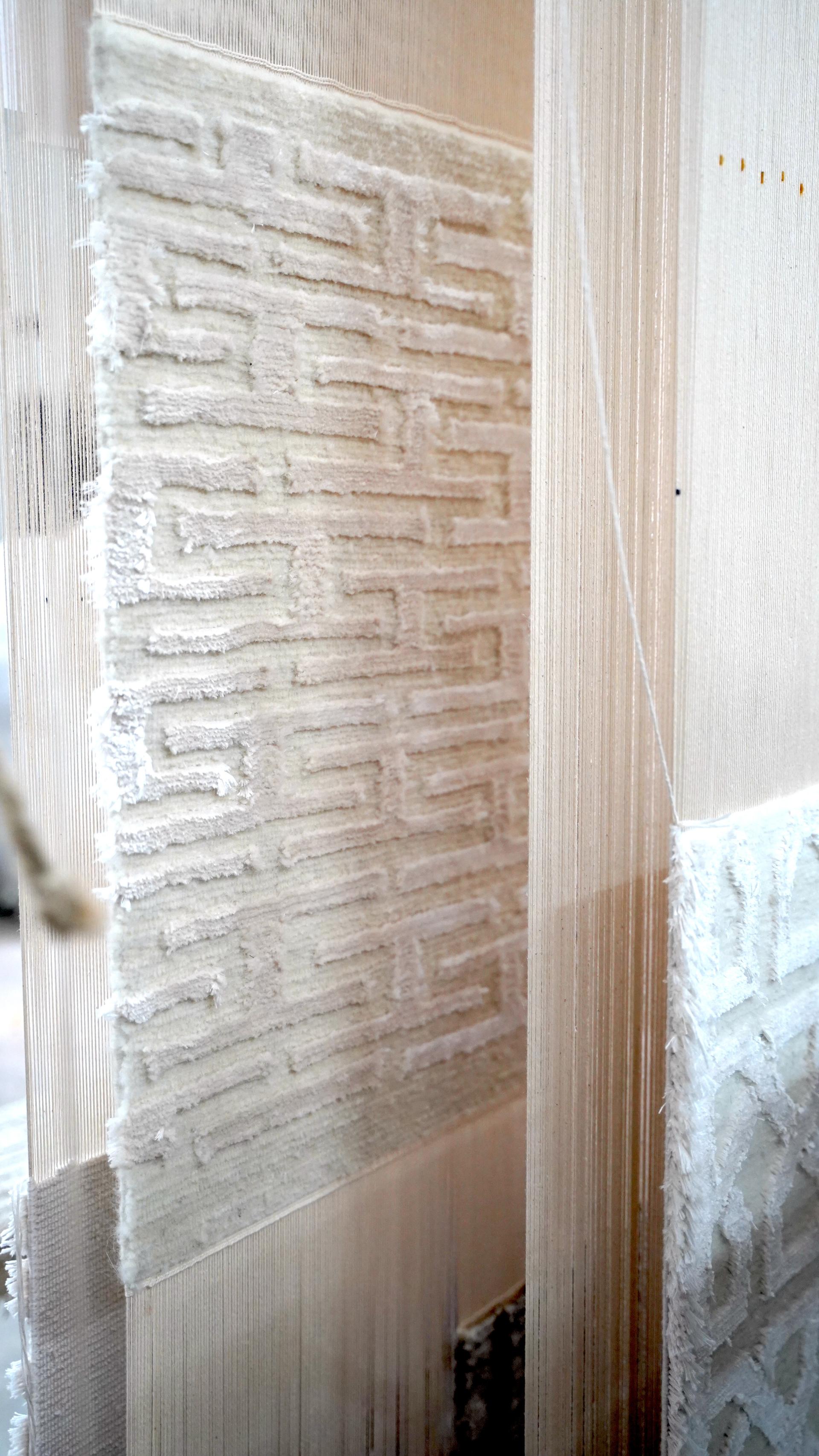
On a hotel project, a strike-off is the sample that every later decision refers to: it fixes the colour, construction, pile and finish that bulk production must match. The approval process matters as much as the sample itself, because a hotel strike-off is usually reviewed by several parties and must stay valid through testing, ordering and delivery.
This post covers the hotel specific side of sampling: what to strike off, how to route approvals, and how to keep a clear record when a project has dozens of designs.
What a strike-off is, briefly
A strike-off is a small piece of the real rug, made with the production yarn, on the production construction, and finished the same way. At Eastern Mills strike-offs are typically 18 by 18 inches. What a strike-off shows and does not show, and how to review one, is covered in our guide to custom rug strike-offs and colour matching. Colour approval before the strike-off is covered in our guide to poms and lab dips.
What should be struck off on a hotel project?
A hotel scheme often has one design in several colourways, several sizes per design, and different constructions in different areas. Striking off every size is rarely necessary. Striking off every combination of construction and colourway usually is.
| Item | Strike off? | Reason |
|---|---|---|
| Each design in each colourway | Yes | Colour and pattern interact differently in each colourway |
| Each construction, such as tufted and knotted | Yes | The same colours read differently in each |
| Each size of the same design | Usually no | Approve size variations on scaled artwork instead |
| Each pile height or finish variation | Yes | Carving, high and low pile and washing change the look |
| Corridor broadloom alongside room rugs | Yes, side by side | Guests see them together at the room door |
| Spare stock | No | It is made from the approved standard with the main order |
Choose the strike-off section deliberately. It should include every colour in the design and its finest detail. For a border design, include a corner.
Who needs to sign off?
On residential work one person usually approves. On a hotel project the list can include the interior designer, the owner or developer, the operator, a brand standards team, and the procurement agent who will issue the order. Each looks for different things.
| Party | Usually checks |
|---|---|
| Interior designer | Colour, scale, texture and fit with the scheme |
| Owner or developer | Budget against the quotation, overall look |
| Operator | Durability, cleaning, how soiling will show |
| Brand standards team | Compliance with the brand's interior standards |
| Procurement | That the sample matches the quoted specification |
The practical rule is one consolidated response per round. The lead designer collects comments, resolves contradictions and sends a single written reply. A factory that receives separate and conflicting comments has to guess which one wins.
Mock-up rooms
Many hotel projects build a mock-up room before the main fit out. It is the best place to approve a guest room rug, because it shows the rug in the real light, next to the real headboard, curtains and furniture, and at the real scale of the room.
If a mock-up is planned, ask for the strike-off in time to place it there, or for a full size sample of the guest room rug if the budget allows. A colour that looks right on a table can look too strong across two square metres beside a pale carpet.
Strike-offs and testing
If the project names a fire standard or another performance test, testing is arranged per order on the approved construction. The sample tested must match the construction ordered: the same fibre, pile weight, backing and any treatment. A change made after testing, such as a heavier pile or a different backing, may need a new test.
So the order of steps matters. Agree the construction, approve the strike-off, then test. Changing colour alone usually does not change the construction, but confirm this with the project's fire consultant rather than assume it.
How to record approvals on a multi design project
A hotel with twenty designs can generate sixty or more samples across rounds. Without a register, it becomes unclear which one was approved.
- Give every sample a reference number and round number.
- Keep a register with design, colourway, construction, round, date sent, comments and status.
- Approve in writing, quoting the sample reference.
- Keep a sealed half of each approved sample with the project team and the other half at the factory.
- Quote the approved references on the purchase order.
Where an approval is given with comments, say clearly whether a further round is wanted or whether production may proceed with the change. The second is faster and carries more risk.
Strike-off approval checklist
- Strike-off list agreed: every design, colourway and construction
- Strike-off section chosen to include all colours and the finest detail
- Approvers named, with one lead to consolidate comments
- Mock-up room date known, if there is one
- Testing requirements named before final approval
- Sample register kept with reference numbers and rounds
- Written approval quoting sample references
- Sealed samples held by both sides
At Eastern Mills, dyeing, hand tufting, hand knotting and finishing all happen in house in Bhadohi, which keeps sampling and bulk production within one operation. See our hand tufted rugs for hotels and custom rugs pages for how sampling fits into a project.
Frequently asked questions
How many strike-off rounds should a hotel project expect?
One or two per design is common. Extra rounds usually trace back to changing references or comments from too many people.
Can a strike-off be sent for fire testing?
Testing is arranged per order to the project's named standard, on a sample that represents the ordered construction. Agree with the factory and the test laboratory what size and number of pieces are needed.
Should every size be sampled?
Usually not. Approve one strike-off per design, colourway and construction, and approve the other sizes on scaled artwork.
What if the operator rejects a sample the designer approved?
Treat it as a new round. This is why all approvers should be named before the first sample is sent.
To plan sampling for a project, send your rug schedule.


