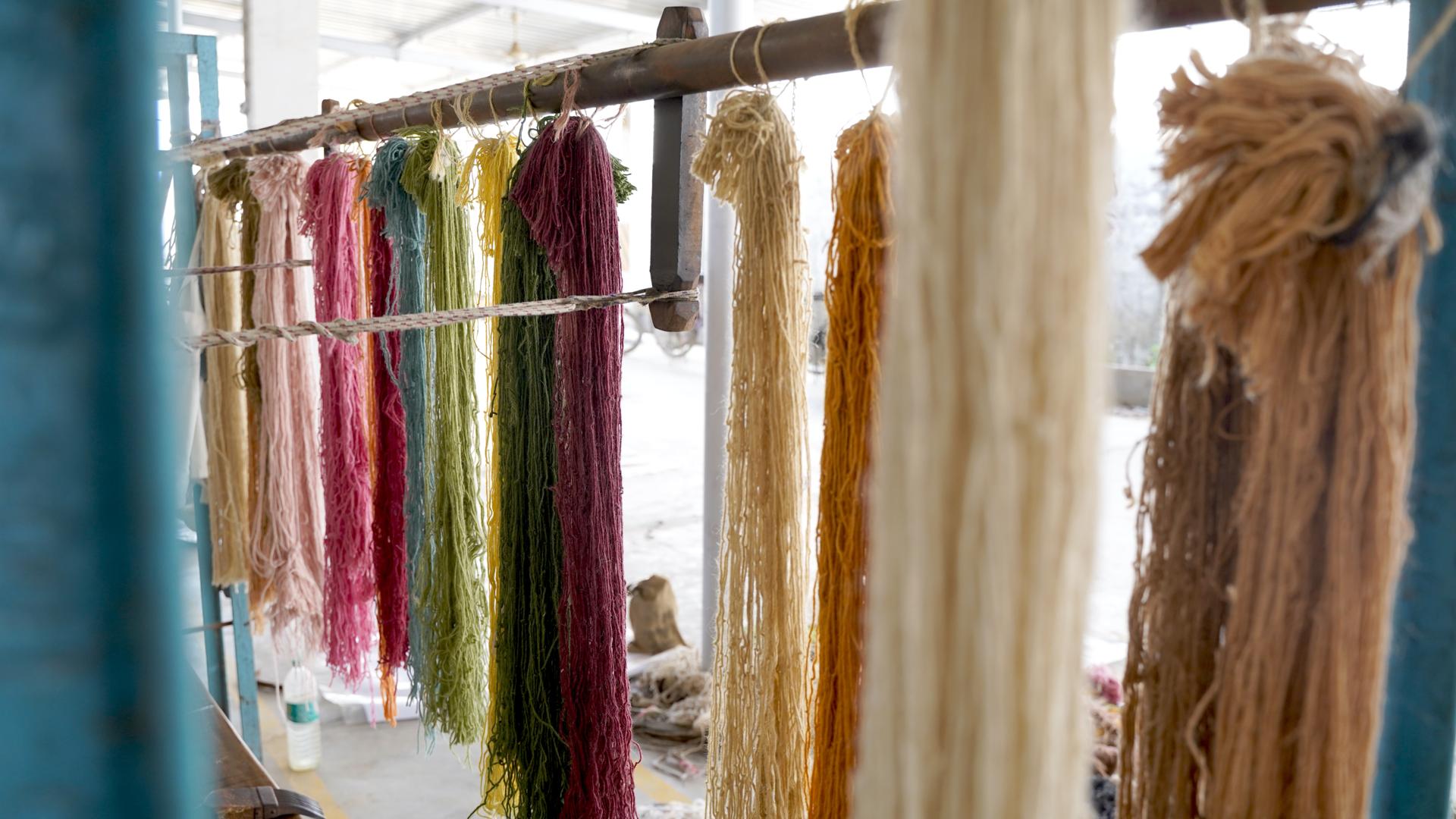
Custom rug development moves through four approvals: the artwork, the yarn colours, a strike-off, and the finished piece before dispatch. A strike-off is a small sample, woven in the real construction, fibre and colours, that shows a section of the design at full scale. Approving it carefully, in writing and against physical references, is what makes the bulk order match.
What are the stages of custom rug development?
| Stage | What you receive | What you are approving | What to check |
|---|---|---|---|
| Artwork | A scaled drawing or digital rendering | Layout, proportion, motif scale | Size, border widths, where the design sits against furniture |
| Colour | Dyed yarn samples, often called lab dips or poms | Each individual colour | Match to your reference under the right light |
| Strike-off | A small woven or tufted sample | Colour in the pile, texture, pile height, hand feel, quality | How colours sit next to each other, sheen, density |
| Pre-dispatch | Photographs or an inspection of the finished rug | The piece itself | Size, overall balance, finish, edges |
Each stage narrows the risk. Changing a colour at yarn stage costs a small dyeing. Changing it after the rug is woven means weaving it again.
How does colour matching work?
You supply a reference for each colour. The dyer develops a recipe on the actual yarn, dyes a small lot, and compares it with the reference. If it is off, the recipe is adjusted and the trial repeated. The approved recipe is recorded so that production lots, and future orders, can be dyed to it.
Three things make matching faster and more accurate.
- Send physical references. Fabric cuttings, yarn, paint cards, standard colour codes from a system the factory holds, or a previous sample. A colour on a screen is not a reference, because every screen shows it differently.
- Say what the reference is and what you want from it. A matte paint card and a wool pile will never look identical. Tell the dyer whether you want the same depth, the same undertone, or the closest overall impression.
- Agree the light. Two samples can match in daylight and differ under warm indoor lighting. This effect is called metamerism. Judge colours under daylight and under the light the rug will live in.
The fibre matters as well. The same recipe looks different on wool, silk and viscose, because each reflects light differently, so colours are always developed on the fibre that will be used.
Eastern Mills dyes in house for all sampling and custom rugs, and matches to Pantone references or to physical swatches.
What is a strike-off, and what does it show?
A strike-off is a piece of the real rug in miniature. It is made on the same kind of loom or frame, with the production yarn, at the production quality, and finished the same way. At Eastern Mills strike-offs are typically 18 by 18 inches, and sample development is invoiced separately.
It shows:
- Colour as it reads in the pile, which is deeper than in a yarn sample
- How neighbouring colours affect each other
- Texture, pile height, density and hand feel
- How fine the design detail can be in the chosen quality
- The effect of washing and finishing
It does not show:
- The whole composition. A corner of a large design cannot tell you whether the overall balance works. Use the scaled artwork for that.
- How a colour reads across a large area. A colour that looks rich in a small sample can feel much stronger across a full rug.
- Size accuracy of the final piece.
Ask the factory which part of the design the strike-off represents, and choose a section that contains every colour and the most detailed motif.
How should you review a strike-off?
- Lay it flat on the floor, not on a desk. Rugs are seen from standing height.
- Look from both ends. Pile leans one way, and the rug looks lighter from one direction and darker from the other.
- Compare each colour with your original reference, in daylight and in the intended lighting.
- Check the hand feel and thickness against anything you specified.
- Turn it over and check the back, the density and the finish.
- Write feedback colour by colour and point by point.
Feedback should be specific enough to act on. "Make the blue warmer" can be read in many ways. "Colour 3 should move toward reference B, less green, same depth" gives the dyer a direction. If something is right, say so, so it is not changed in the next round.
What does approval actually mean?
Approval is a commitment by both sides. You are confirming that bulk production matching this sample will be accepted. The factory is confirming that it will match it.
Good practice is simple.
- Approve in writing, naming the sample reference, date and any agreed changes.
- Cut the approved sample in two, or have two made. Each party keeps one as the sealed standard.
- Record the specification alongside it: construction, quality, fibre, pile height, finishing.
- Agree what variation is acceptable. Handmade rugs vary slightly in shade and size, and a tolerance agreed now prevents a dispute later.
If you approve with comments, be clear whether you want a revised strike-off or are approving production with the change. The second saves time and carries more risk.
Why do custom developments get delayed?
- References arrive late or change mid way.
- Feedback is given from photographs instead of from the physical sample.
- Several people comment separately and contradict each other.
- The size or construction changes after sampling, which changes the yarn and the price.
- Approval is verbal, and later nobody is sure what was agreed.
One decision maker and one consolidated written response per round fix most of these.
What happens after approval?
Yarn for the whole order is dyed in production lots against the approved standard, and weaving begins. For large or complex pieces, ask for photographs on the loom. Before dispatch, Eastern Mills shares close up photographs of the finished rug for review. That is the final approval point, since claims are not accepted after dispatch.
For reorders, the most reliable reference is the original approved sample. Eastern Mills prefers the original sample to be returned for matching on later orders, alongside its own records.
Custom development checklist
- Finished size, shape and construction confirmed
- Physical colour reference for every colour
- Lighting conditions stated
- Artwork approved at scale
- Strike-off section agreed
- Written, itemised feedback each round
- Approval in writing, with a sealed sample kept by both sides
- Tolerances for shade and size agreed
- Pre-dispatch review scheduled
Frequently asked questions
How many strike-off rounds are normal?
One or two for most designs. Each extra round usually traces back to unclear references or feedback, so time spent on the brief is repaid here.
Can a factory match a Pantone colour exactly?
It can match closely on the chosen fibre. A printed chip and a dyed wool pile reflect light differently, so approve the match on yarn or in a strike-off, not on paper.
Do I pay for strike-offs?
Usually yes. At Eastern Mills sample development charges are invoiced separately.
Can custom rugs be made in irregular shapes?
Yes. Rounds, ovals and irregular outlines are possible. For non standard shapes, Eastern Mills asks for a physical template.
How wide can a custom rug be?
Eastern Mills makes custom sizes up to 14 feet, about 425 centimetres, as a standard width. Wider pieces are available with a surcharge.
To start a custom development, see our custom rugs page or send your brief. Our guide to briefing a rug manufacturer lists what to include, and our capabilities page covers dyeing and sampling on site.


