Machine tufted carpet, plain or printed, is the economical choice for large areas of hotel floor where cost per square metre, speed of supply and easy replacement matter most. Hand tufted rugs are the choice where a piece needs its own size, texture or yarn colour, in quantities too small or designs too particular for a machine line.
What machine tufted carpet is
A tufting machine pushes yarn through a primary backing with a bar of needles across the full width of the roll, many rows a minute. A latex coat and a secondary backing lock the tufts in, or the carpet is given a cushion or tile backing instead. Machine tufting is the most common carpet construction in the world, both as broadloom and as carpet tiles.
There are three main ways to put a pattern into machine tufted carpet.
- Coloured yarns. The pattern comes from yarn dyed before tufting, which suits stripes, textures, tweeds and small geometrics.
- Machine controlled texture. Modern machines can vary pile height or place yarns across the width to form textured or simple coloured patterns.
- Printing. The carpet is tufted in undyed or pale yarn, and colour is applied afterwards, usually by jet injection of dye into the pile. Printing allows detailed, many coloured designs with a low setup cost per design.
Nylon is the most common fibre. Plain carpet is often made from solution dyed nylon, where the pigment is added before the fibre is formed. Printed carpet needs a yarn that takes dye after tufting, which is typically nylon or wool.
What hand tufting does differently
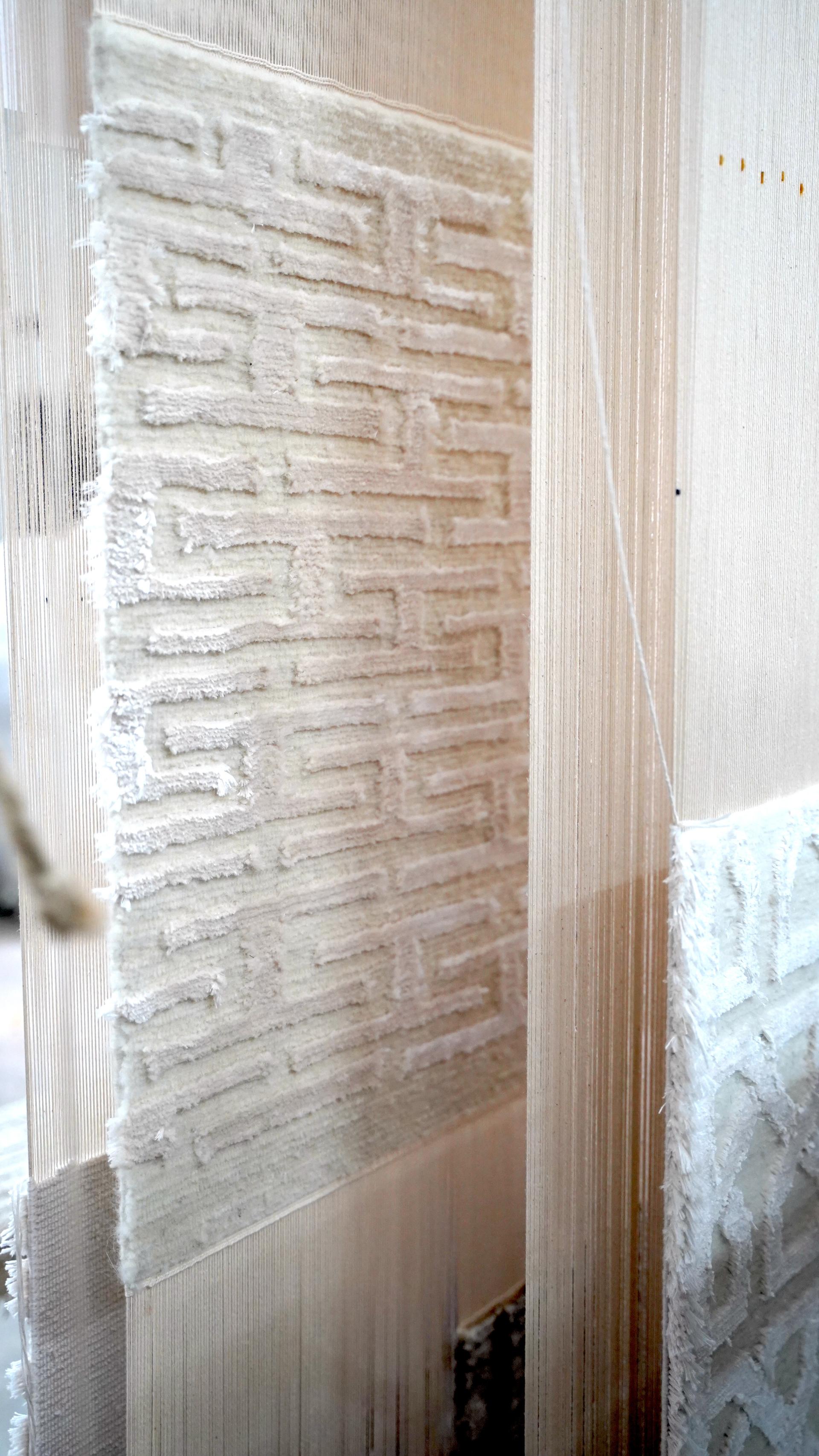
In a hand tufted rug, every colour is a yarn that was dyed before tufting, so the colour runs through the full depth of the pile. The tufter follows a drawing on the cloth with a hand held gun, changing yarn for each colour area, and can change pile height and texture within the rug. After tufting, the back is latexed and covered with a secondary cloth, and the face is sheared, carved where needed and finished by hand.
The result is a product with defined edges and its own composition, made to a finished size. It is laid loose rather than fitted.
Printed colour and yarn dyed colour
This is the difference specifiers notice first on a sample.
- In printed carpet, dye is applied to the surface and has to penetrate the pile. In dense or deep pile, penetration may be incomplete, so as the pile opens up in traffic, lighter yarn near the base can show. Ask to see a cut edge of the sample.
- Printed edges between colours are slightly soft, because dye spreads a little into neighbouring tufts. Yarn dyed edges are as sharp as the tufting.
- Printed carpet can carry photographic or very detailed artwork that would take a large number of yarn colours to tuft.
- Yarn dyed colour is uniform through the fibre, so it holds its look as the pile wears down.
Neither is wrong. Printed carpet is a sound choice where detail and cost matter more than depth of colour, and yarn dyed colour is the better route where the rug is a focal piece seen at close range.
Side by side
| Machine tufted and printed | Hand tufted | |
|---|---|---|
| Typical product | Broadloom and carpet tiles | Area rugs and bespoke pieces |
| Usual fibre | Nylon, sometimes wool or blends | Wool, with accent fibres where specified |
| How colour is applied | Yarn dyed, solution dyed or printed after tufting | Yarn dyed before tufting |
| Texture | Level or machine patterned | Cut, loop, high and low pile, hand carving |
| Shape | Rolls and tiles, cut on site | Any outline, made to finished size |
| Cost per square metre | Lower | Higher |
| Setup per design | Low, especially for printing | A strike off per design |
| Replacement | Tiles or seamed patches | Whole rug |
Where machine tufted or printed carpet is the better choice
- Large fitted areas on a controlled budget. Guestroom carpet across many floors, where cost per square metre drives the decision.
- Meeting rooms and spaces with raised access floors. Carpet tiles can be lifted for access and replaced one at a time.
- Back of house and staff areas. Durable, plain nylon is practical and easy to replace.
- Detailed artwork over a large area. Printing reproduces fine imagery across a whole floor without the limits of a yarn palette.
- Aggressive cleaning regimes. Solution dyed nylon tolerates bleach based spot cleaning that would damage wool.
Eastern Mills does not make machine tufted or printed carpet. These are good products in the right place, and a project should source them from a specialist mill.
Where hand tufted is the better choice
- Lobby, lounge and suite rugs, where the rug is a designed object rather than a floor finish.
- Rugs sized to furniture layouts, with a different size for each room type.
- Designs that depend on texture, such as carved outlines or high and low pile.
- Projects that want wool, or wool with silk or viscose highlights, rather than nylon.
- Shaped pieces and rugs that sit inside a stone or timber border.
Combining the two
A common and sensible plan is machine tufted carpet or carpet tiles for the fitted areas and hand tufted rugs for the feature spaces. If the rug yarn is dyed in house, it can be matched to the carpet mill's approved colours. Approve the two side by side, because yarn dyed colour and printed colour read differently even when they are the same reference.
Checklist for comparing quotes
- Fibre, and whether the colour is yarn dyed, solution dyed or printed
- Pile height and face weight, measured on the same basis by each supplier
- Backing type and how the carpet or rug will be installed
- For printed carpet, a cut sample showing dye penetration
- How damaged areas will be replaced over the life of the scheme
- The fire standard named for each area, and who arranges testing
How Eastern Mills fits
Eastern Mills has made rugs in Bhadohi, India, since 1947, with yarn spinning, dyeing, hand tufting and finishing in house. Hand tufted rugs are developed from the project's drawings by a 21 person design team and approved on a strike off, typically 18 x 18 inches. For custom rugs in hotel programmes, the minimum order is 200 square metres per design per colour. Handmade broadloom is also available as contract carpets from a separate broadloom facility.
Frequently asked questions
Is printed carpet less durable than yarn dyed carpet?
Not necessarily in terms of wear. Nylon has high abrasion resistance. The difference is in appearance: if dye has not penetrated the full pile, the colour can lighten as the pile opens up. A cut sample shows how deep the colour goes.
Are carpet tiles machine tufted?
Most are. Tiles suit meeting rooms, offices and areas with raised access floors, because single tiles can be lifted and replaced.
Why does hand tufted cost more per square metre?
Every rug is tufted, sheared and finished by hand, each colour is a separately dyed yarn, and wool costs more than nylon. The price buys design freedom and texture rather than area coverage.
Can a hand tufted rug match a printed carpet?
It can be dyed to the same colour references. Printed and yarn dyed colour look slightly different on the floor, so judge the match on physical samples under the project's lighting. To start, send us the carpet references.


