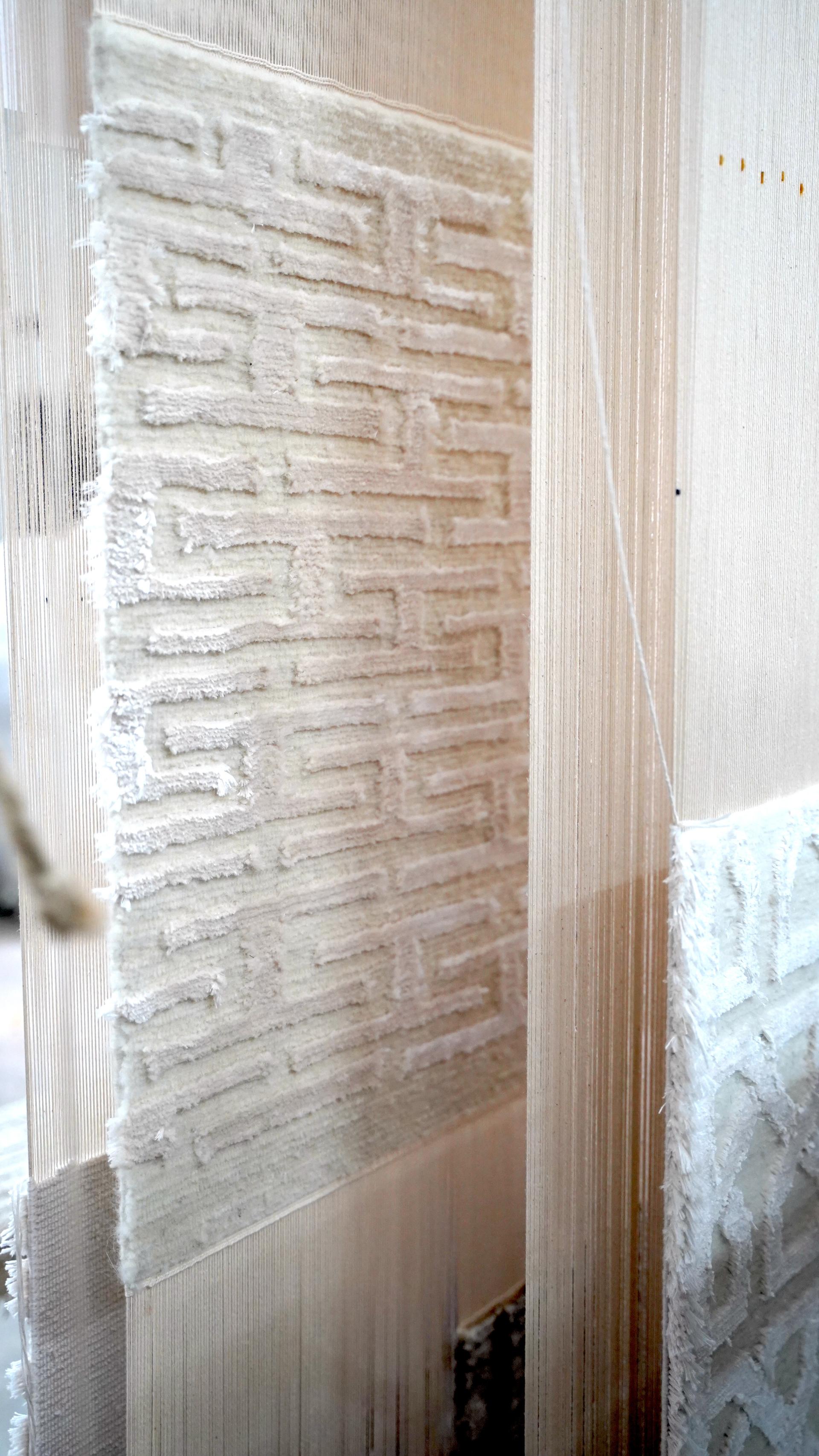
Axminster and hand tufted solve different problems in a hotel. Axminster is a machine woven carpet suited to large areas of patterned wall to wall carpet, such as corridors, function rooms and fitted guestrooms, where one design repeats over a large floor area. Hand tufted is a handmade construction suited to area rugs and bespoke pieces, where each design has its own size, shape, texture or colour range.
How Axminster carpet is made
Axminster is woven on a power loom. For each tuft, the loom selects a length of yarn in the required colour, inserts it into the weave and cuts it, so the pattern is built tuft by tuft while the backing is woven at the same time. Pile and backing form one fabric, and the pile is held by the weave rather than by an adhesive.
Because colour is chosen tuft by tuft, Axminster reproduces detailed, multicoloured patterns with precise registration along the whole roll. That is why it has a long history in hotel corridors, ballrooms and casinos. The pile is usually a level cut pile, and a common hospitality yarn is a blend of 80 percent wool and 20 percent nylon. The carpet is supplied as broadloom and fitted by an installer, stretched over underlay or stuck down.
How hand tufted rugs are made
A hand tufted rug starts as a design drawn on a primary cloth stretched on a frame. The tufter follows the drawing with a hand held tufting gun, shooting yarn through the cloth. The back is then coated with latex to lock the tufts, a secondary cloth is applied, and the face is sheared and, where the design calls for it, carved.
Each colour is a separate dyed yarn, so the colour count is set by the design rather than by the machine. Pile height can change within one rug, loops and cut pile can sit side by side, and the outline of the rug can be any shape. Hand tufting can also produce broadloom on wide frames, but in hotels its main use is the loose rug: guestroom rugs, suite rugs, lobby feature pieces and restaurant rugs, finished to a set size with bound or serged edges.
Side by side
| Axminster | Hand tufted | |
|---|---|---|
| Method | Power loom, tufts inserted and woven in with the backing | Tufting gun through a cloth, then latex and a secondary backing |
| Typical product | Wall to wall broadloom | Area rugs, shaped and bespoke pieces |
| Pattern | Precise, repeating, registered across widths | Free drawing, no repeat needed, curves and irregular outlines |
| Colour count | Limited by the colour positions on the loom | Set by the design |
| Texture | Mostly level cut pile | Cut, loop, high and low pile, carving |
| Run economics | Suited to long runs of one design | Suited to many designs in shorter runs |
| Installation | Fitted by a carpet installer | Laid loose, usually over an underlay |
| Replacement | Damaged area cut out and seamed in | Single rug swapped |
Where Axminster is the better choice
It is worth saying plainly where Axminster wins, because specifying the wrong construction costs a project more than any difference in price.
- Corridors. Long, continuous runs of one pattern, seamed accurately at junctions and turns, are what Axminster looms are built for. A tufted rug is not a corridor product.
- Ballrooms and function rooms. Large open floors with a patterned field that must line up across many widths of carpet.
- Large repeat programmes. A design used across many floors or several properties benefits from a machine process that gives the same result roll after roll.
- Heavy rolling loads. A woven pile with no latex layer, fitted over a suitable underlay, copes well with banqueting trolleys and constant traffic.
Eastern Mills does not make Axminster. Where a project needs it, the corridor and function room carpet should come from an Axminster mill, and the rug maker should work to that mill's colour standards.
Where hand tufted is the better choice
- Guestroom and suite rugs. Rugs sized to the furniture plan, often a different size for each room type, in a design created for the property.
- Shaped and irregular pieces. Circles, organic outlines, and rugs cut around columns or built in furniture.
- Texture as part of the design. High and low pile, loop and cut areas and carved outlines give a sculpted surface that a level loom pile does not.
- Small quantities per design. A lobby may need a single rug of one design. That is uneconomic to set up on a loom and normal for tufting.
- Particular yarns. Wool with silk or viscose accents, heathered or chunky yarns, and blends spun for one project.
Using both on one project
Many hotels combine the two. A common split is Axminster in corridors, function rooms and fitted guestroom carpet, with hand tufted rugs in the lobby, lounges, suites and restaurants. The point that needs managing is colour. Two factories and two constructions will not match by chance.
- Agree which product holds the master colour standard, usually the carpet with the largest area.
- Give the rug maker the carpet mill's approved colour references as physical samples, not only as codes.
- Approve rug strike offs next to the carpet samples, under the lighting planned for the space.
- Fix the transitions on the floor plan early, so rug sizes are drawn against the finished carpet layout.
Questions that decide the construction
- Is the floor continuous, like a corridor, or broken into furniture zones?
- Does the pattern need to register across seams?
- How many designs are there, and how many square metres of each?
- Does the design rely on texture or carving, or on colour alone?
- Will the piece be fitted by an installer, or laid loose by the hotel's own team?
- How will a damaged area be replaced in five years' time?
If the answers point to continuous floor, a large area of one design and a fitted installation, Axminster is usually the right product. If they point to defined zones, several designs and loose laying, hand tufted usually is.
How Eastern Mills fits
Eastern Mills has made rugs in Bhadohi, India, since 1947 and is a third generation family business. Yarn is spun and dyed in house, and hand tufted hotel rugs are made in the 50,000 SQM main facility, with strike offs, typically 18 x 18 inches, approved before production starts. The minimum order is 200 square metres per design per colour. For fitted areas where a project wants a handmade product rather than a machine woven one, the company also makes contract carpets in its separate broadloom facility.
Frequently asked questions
Is Axminster more durable than hand tufted?
For wall to wall use under constant traffic, a well specified Axminster generally outlasts a tufted construction, because its pile is woven into the backing rather than held by latex. For a rug in a guestroom or suite, a dense wool hand tufted rug is suited to a normal refit cycle.
Can hand tufted be used as wall to wall carpet?
Yes. It can be made as broadloom on wide frames, and it suits bespoke and shaped installations. For long corridor runs, a woven construction is usually more practical.
Can Axminster be made into rugs?
Yes, it can be cut and bound into rugs. The result is a repeating pattern cut to size, rather than a rug composed with its own border and field.
Do both constructions need fire testing?
Usually. Requirements depend on the jurisdiction and the area, and loose rugs in public areas are often included. For Eastern Mills products, testing to the project's named standard is arranged per order.
To plan a rug package alongside an Axminster carpet scheme, send the project brief.