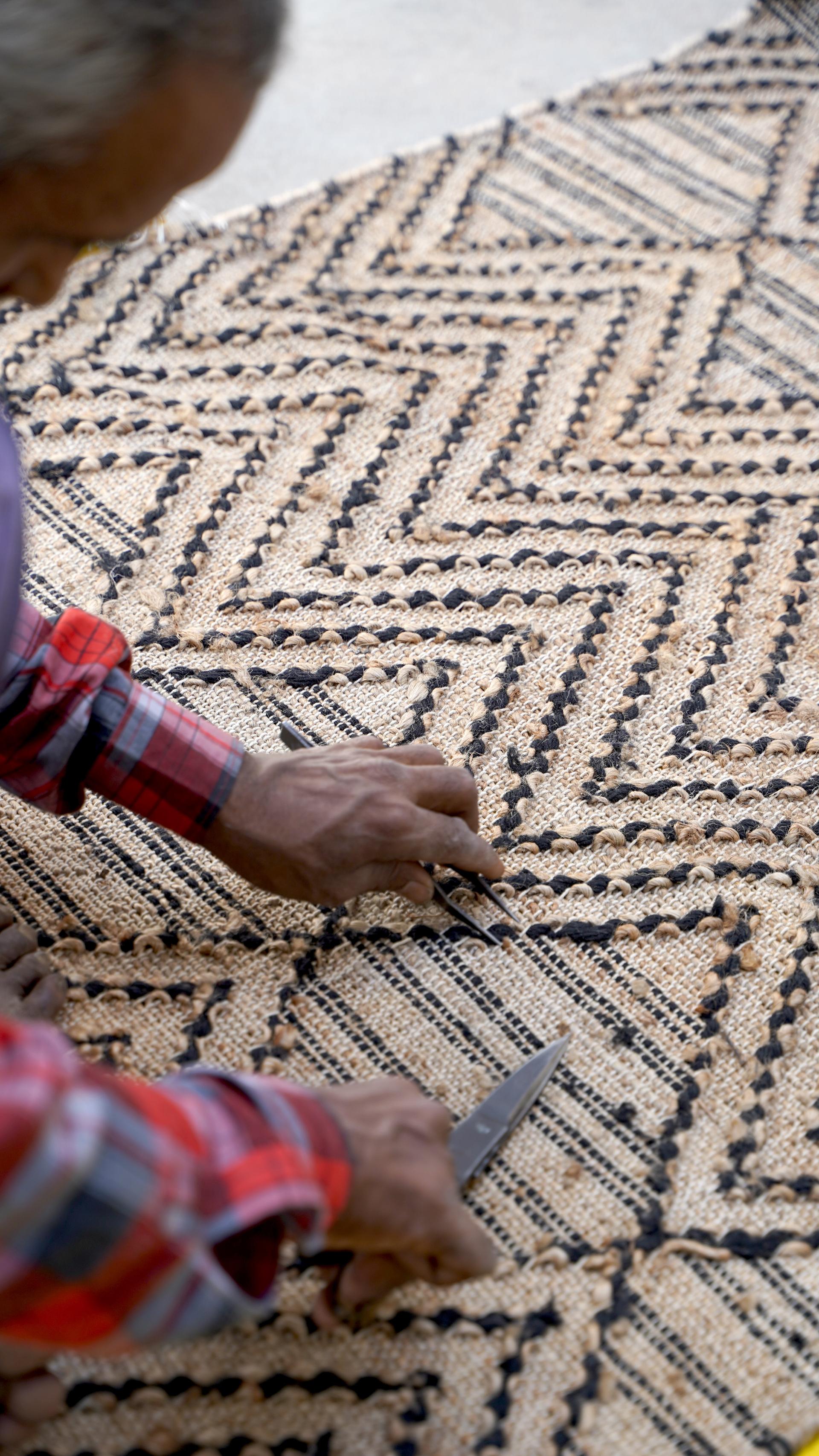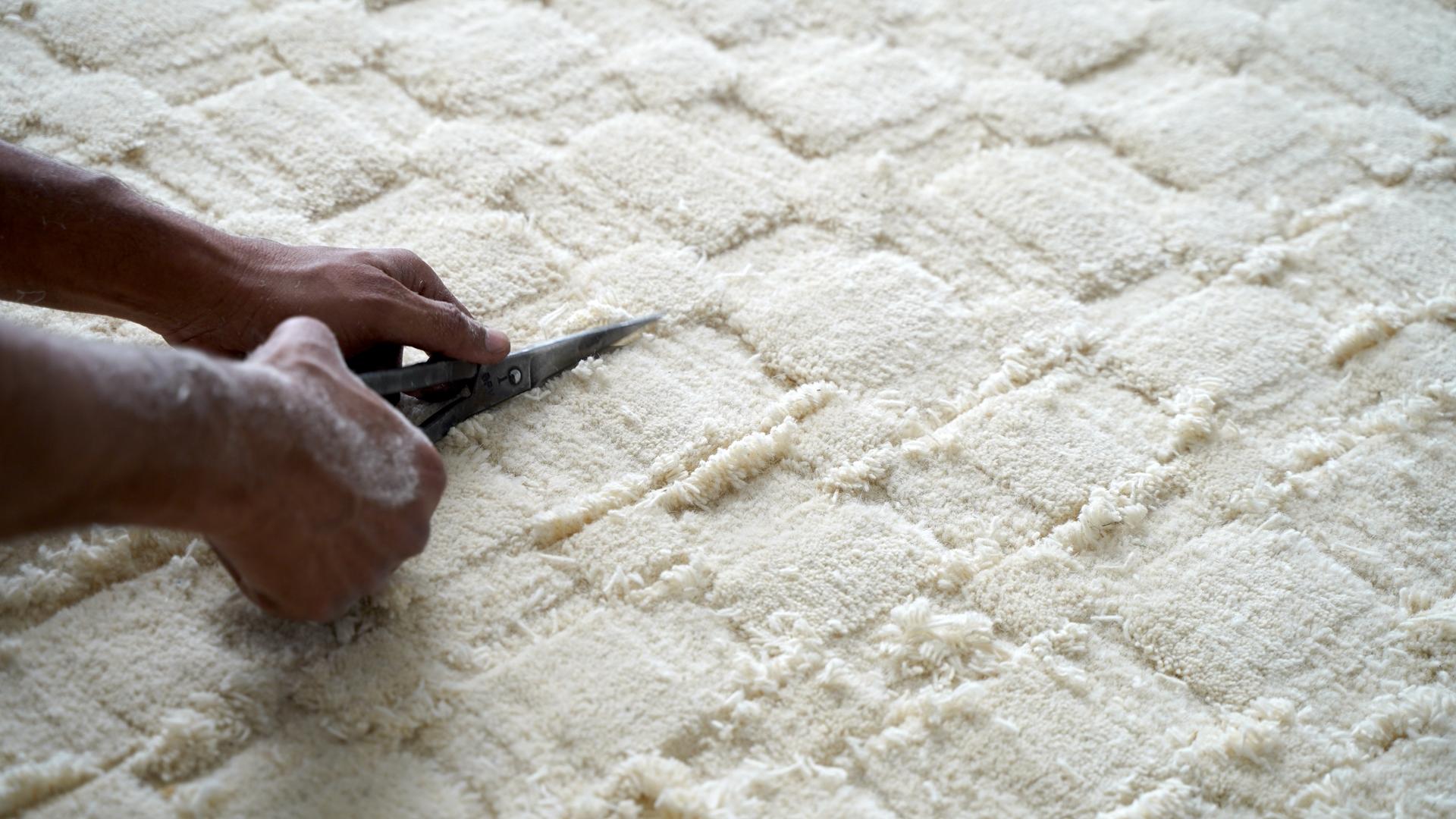
In a hand tufted rug, cut pile gives a soft, plush surface with clear colour, loop pile gives a firmer, textured surface that hides footprints, cut and loop draws the pattern in texture as well as colour, and carving cuts channels into the pile to outline motifs. Each behaves differently under hotel traffic, wheels and cleaning, so the texture should be chosen area by area.
How each texture is made
The tufting gun shoots yarn through the primary cloth from the back of the frame. Depending on the tool and setting, the yarn is either left as a continuous loop on the face or cut as each tuft is formed. Tufters can change between the two within a rug, and pile height is set for each area.
After tufting and backing, the rug is sheared to level the pile and sharpen the design. Carving comes next: the finisher uses electric clippers to cut a narrow channel or a bevel along the edge of a motif, which lowers the pile at that line and makes the shape stand out. Further shearing can tip the tops of loops in selected areas to create a third texture.
Cut pile
Cut pile is the most common texture in hotel rugs. Each tuft ends in cut fibre tips, which gives a soft, velvety surface and shows colour at full depth.
- Strengths: comfort underfoot, rich colour, a clean surface for detailed designs, easy to vacuum.
- Watch for: shading and footmarks, because the colour changes as tufts lean in different directions. This is a property of cut pile, not a defect. It is more visible in plain, pale colours and in taller pile.
- Fits: guestrooms, suites, lounges, and lobby rugs when kept low and dense.
Loop pile
Loop pile leaves the yarn as unbroken loops on the surface. The loop is held at both ends, which makes it firm and resistant to crushing.
- Strengths: resists flattening, hides footprints and shading, has a crafted, textural look, and keeps its appearance well in traffic.
- Watch for: snagging. A loop can be caught by a suitcase wheel, a stiletto heel, jewellery or a pet's claw and pulled into a run. Loops in a large or loose yarn are more at risk than tight, low loops.
- Fits: lounges, meeting rooms and guestrooms in low, tight loops. Use caution on routes with heavy wheeled traffic.
Housekeeping should vacuum loop pile with suction, or with a brush set high, rather than an aggressive beater bar, which can fuzz or pull the loops.
Cut and loop
Cut and loop combines both textures in one rug. The pattern appears through the contrast between the matte loops and the deeper colour of the cut areas, even in a single colour. High and low variations add a second level of relief.
- Strengths: pattern without relying on many colours, which suits tonal schemes; a hand crafted look; useful for disguising soiling and wear.
- Watch for: the cut areas will show shading while the loop areas will not, which is part of the effect. Large height differences can catch wheels and feet.
- Fits: lobbies, lounges, restaurants and suites, where texture is part of the design.
Carving
Carving outlines a motif by cutting into the pile along its edge. It is a finishing technique rather than a type of pile, and it can be applied to cut pile, or used at the boundary between cut and loop areas.
- Strengths: gives the design a crisp, dimensional outline, and can make a tonal or single colour design legible.
- Watch for: channels collect grit and need thorough vacuuming. Deep carving in a heavy traffic area will gradually flatten as the surrounding pile is crushed. Carving lowers the pile at the carved line, which is a point of wear.
- Fits: suites, feature rugs, lounges and lobby rugs where the design is seen from a distance and traffic is managed.
Comparison
| Texture | Look | Hotel strengths | Watch for | Typical areas |
|---|---|---|---|---|
| Cut pile | Soft, plush, full colour | Comfort, detail, easy cleaning | Shading, footmarks | Guestrooms, suites, lounges |
| Loop pile | Firm, textural, matte | Crush resistance, hides marks | Snags from wheels and heels | Lounges, meeting rooms, guestrooms |
| Cut and loop | Patterned in texture | Tonal designs, hides soiling | Uneven shading by design | Lobbies, restaurants, suites |
| High and low | Relief, sculpted | Depth in a single colour | Height steps on routes | Suites, feature rugs |
| Carving | Crisp outlines | Defines motifs | Grit in channels, wear at edges | Feature and lobby rugs |
Specifying texture
- Mark the texture for each area of the design on the drawing, not only in the description.
- Give the pile height for each texture, and the height difference where pile levels change.
- State carving width and depth, or ask the manufacturer to propose them on the strike off.
- Choose loop size and tightness with the traffic in mind.
- Name any accessibility limit that applies, because it caps the highest pile in the rug.
- Approve the texture on a strike off. Texture is hard to judge from a render or a photograph.
- Ask for the strike off in the same yarn and colour as production, because texture reads differently in different shades.
How Eastern Mills fits
Eastern Mills makes hand tufted rugs in cut pile, loop pile and combinations of the two, with shearing and carving done in its own finishing department in Bhadohi, India. Its 21 person design team works out texture and carving with the project's designer, and each design is approved on a strike off, typically 18 x 18 inches, before production of hand tufted hotel rugs begins. Shaped and textured pieces are covered on the custom rugs page.
Frequently asked questions
Is loop pile more durable than cut pile?
Loop pile resists crushing better and hides traffic marks, so it often looks newer for longer. It is more vulnerable to snagging, so the choice depends on what will cross the rug.
Is shading in a cut pile rug a defect?
No. Shading happens when tufts lean in different directions and reflect light differently. It is a normal property of cut pile and is more visible in plain, pale colours.
Can carving be used in guestroom rugs?
Yes, at a modest depth. Shallow carving gives definition without creating deep channels that collect grit or wear quickly.
Can one rug combine every texture?
Yes. A single hand tufted rug can have cut, loop, high and low pile and carved outlines. Each added texture adds finishing time, and the combination should be tested on the strike off.