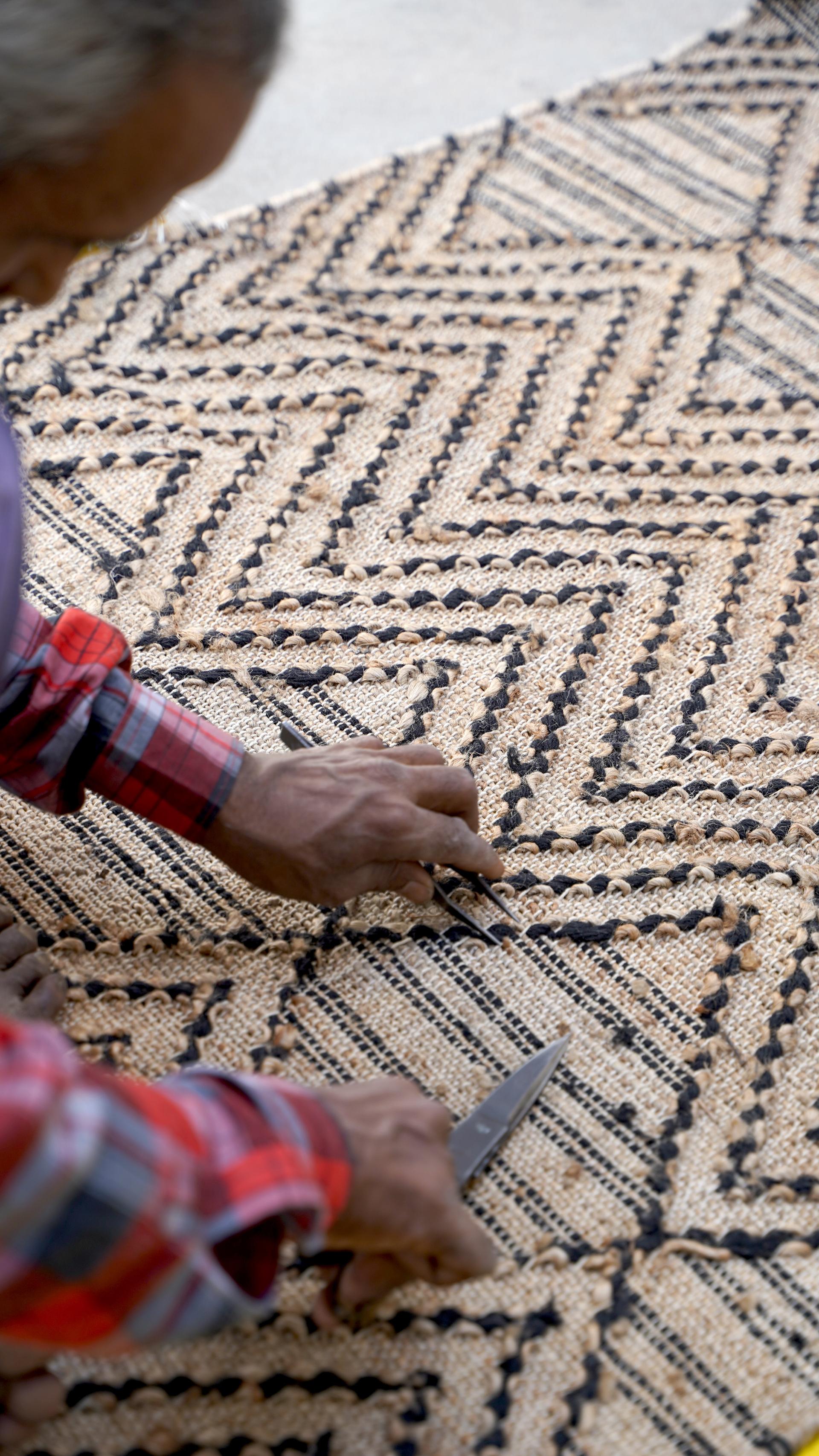
A flatweave rug is woven from warp and weft alone, with no pile. That makes it thin, light, usually reversible and quick to produce compared with a knotted rug. Dhurrie, kilim and soumak are the main flatweave types: a dhurrie is the Indian flatweave, traditionally cotton, a kilim is a slit woven tapestry, and a soumak wraps the weft around the warp for a thicker, textured face.
How is a flatweave constructed?
Every woven rug starts with a warp, the set of threads running the length of the loom. In a pile rug, knots or loops are added to the warp to stand up as a surface. In a flatweave, the coloured weft yarn is passed over and under the warps and beaten down tightly, and the weft itself becomes the face of the rug.
Most flatweaves are weft faced. The weft is packed so densely that it covers the warp completely, and the pattern is made by changing weft colours. The warp shows only at the ends, as fringe or a hemmed edge.
Because there is no pile to tie or tuft, a flatweave uses less yarn per square metre and grows faster on the loom. That is the reason it usually costs less than a pile rug in the same fibre.
What are the main types of flatweave?
| Type | Structure | Look and feel | Reversible | Typical fibres |
|---|---|---|---|---|
| Dhurrie | Plain weft faced weave. Colours interlock or dovetail where they meet | Flat, crisp, stripes and geometrics | Yes | Cotton, wool, or wool on a cotton warp |
| Kilim | Slit tapestry weave. Small slits form where two colours meet along the warp | Flat, bold angular motifs | Yes | Wool |
| Soumak | Weft wrapped around the warps instead of simply interlaced | Thicker, braided or herringbone texture | No, loose yarn ends on the back | Wool, sometimes jute or cotton |
| Handloom textured flatweave | Woven on a pedal loom with heavier or mixed yarns, sometimes with raised patterns | Chunky, textural, often solid or tonal | Often | Wool, jute, hemp, linen, cotton, blends |
| Rag or chindi rug | Strips of recycled fabric used as weft | Casual, multicoloured, soft | Yes | Recycled cotton and mixed textiles |
What makes a dhurrie a dhurrie?
Dhurrie is the Indian name for a flat woven rug, and the tradition is centuries old. The classic dhurrie is all cotton, light and washable. Modern export dhurries are very often wool on a cotton warp, which gives more body, better soil resistance and richer colour. One traditional method is the panja dhurrie, named after the metal claw tool used to beat the weft down by hand.
How is a kilim different?
Kilim comes from the weaving traditions of Turkey, Iran and Central Asia. Each colour area is woven separately, and where two colours meet along a vertical line, the wefts turn back around neighbouring warps and leave a small slit. Designers avoid long vertical lines for that reason, which is why kilim patterns are built from diagonals and steps. In today's trade the words kilim and dhurrie are often used loosely for any flatweave, so confirm the structure, not the name.
Where does soumak fit?
In soumak the weft wraps around pairs of warps as it travels across, producing a surface like a row of fine braids. It is thicker and more hard wearing than a plain flatweave and has a definite face and back.
Where do flatweaves work best?
- Dining rooms. Chairs slide easily over a flat surface, and crumbs do not sink into pile.
- Hallways, kitchens and entrances. Low profile under doors and easy to shake out or vacuum.
- Layering. A large flatweave makes a good base under a smaller pile rug.
- Warm climates and summer use. Cooler under foot than deep pile.
- Casual, relaxed interiors. Stripes, checks and textured neutrals suit the construction.
- Online retail. Lighter and less bulky to ship than pile rugs, and they can be folded.
They are less suited to places where softness and sound absorption are the priority, such as bedrooms and media rooms, unless paired with a thick underlay.
What are the practical drawbacks?
- They slide. A thin, light rug moves on a hard floor and needs a non slip underlay.
- Less cushioning and less acoustic benefit than pile.
- Corners and edges can curl if the weave tension or finishing is poor.
- Loosely packed flatweaves snag and wear quickly. Density is what separates a good one from a poor one.
- Slit woven kilims are weaker along long slits.
Which fibre should you choose?
Wool gives the most durable and best looking flatweave, with good colour and soil resistance. Cotton is softer, cheaper and washable, but shows dirt and flattens. Jute and hemp give a natural, textured look for dry rooms. Blends such as wool and cotton, or wool and jute, balance cost and hand feel. Our guide to choosing rug fibres compares them in detail.
Ask about the warp as well. A strong, even cotton warp keeps a flatweave square and flat.
What should you ask a supplier?
| Question | Why it matters |
|---|---|
| What is the weave structure? | Dhurrie, kilim and soumak behave differently in use |
| What are the weft and warp fibres, by percentage? | Sets durability, care and labelling |
| What is the weight per square metre? | The simplest measure of how substantial the rug is |
| How densely is the weft packed? | Loose weaves snag and distort |
| Is it reversible? | A selling point, and it doubles the wearing surface |
| How are the ends finished? | Fringe, hemmed, bound or tucked back, each with a different look and durability |
| How are the sides finished? | Straight, firm selvedges show good weaving |
| Is it washed, and will it shrink? | Flatweaves, especially cotton, can change size when washed |
| What size and squareness tolerance applies? | Flatweaves can skew if tension is uneven |
| What is the colourfastness to rubbing and water? | Dark cotton colours can transfer if not well fixed |
| What is the maximum width without a seam? | Depends on the loom |
| What are the minimums per design and colour? | Sets how wide a range you can afford to launch |
Ask for a full size sample or a large cutting before committing. A flatweave should feel firm, lie flat without help, and show clean, straight edges.
How are flatweaves finished and cared for?
After weaving, the rug is checked, washed where the quality calls for it, stretched to size and dried flat. Ends are secured by knotting the fringe, hemming, or binding. Good finishing is what keeps the rug square.
In use, flatweaves should be vacuumed without a beater bar, turned over and rotated periodically, and always laid on an underlay. Small cotton dhurries are often machine washable. Wool flatweaves should be professionally cleaned.
Flatweaves at Eastern Mills
Flatweave is one of the constructions Eastern Mills weaves in house in Bhadohi, alongside hand knotted, hand tufted and handloom rugs. Wool yarn is spun in house and colours for sampling and custom work are dyed on site, and the company also works in cotton, jute, hemp, linen and custom blends. Standard widths run up to 14 feet, about 425 centimetres. See our flatweave rugs and handloom rugs pages for more.
Frequently asked questions
Is a dhurrie the same as a kilim?
Both are flat woven rugs without pile. A dhurrie is the Indian form, traditionally cotton with interlocked colour joins. A kilim is the West and Central Asian form, usually wool with slit joins. The names are often used interchangeably in retail.
Are flatweave rugs durable?
A tightly woven wool flatweave is very durable and can be used on both sides. A loosely woven or all cotton one wears faster. Density and fibre make the difference.
Do flatweave rugs need a rug pad?
Yes. An underlay stops the rug sliding, protects the floor and adds some cushioning.
Can flatweaves be made in custom sizes and colours?
Yes. Flatweaves are woven to order on handlooms, so size, colour and pattern can all be specified. See our custom rugs page.
Are flatweaves cheaper than hand knotted rugs?
Generally yes, because they use less yarn and take less time to weave. Fine, complex flatweaves in wool can still be costly.
To request flatweave samples or a quotation, contact Eastern Mills with the fibre, size and quantity you have in mind.

