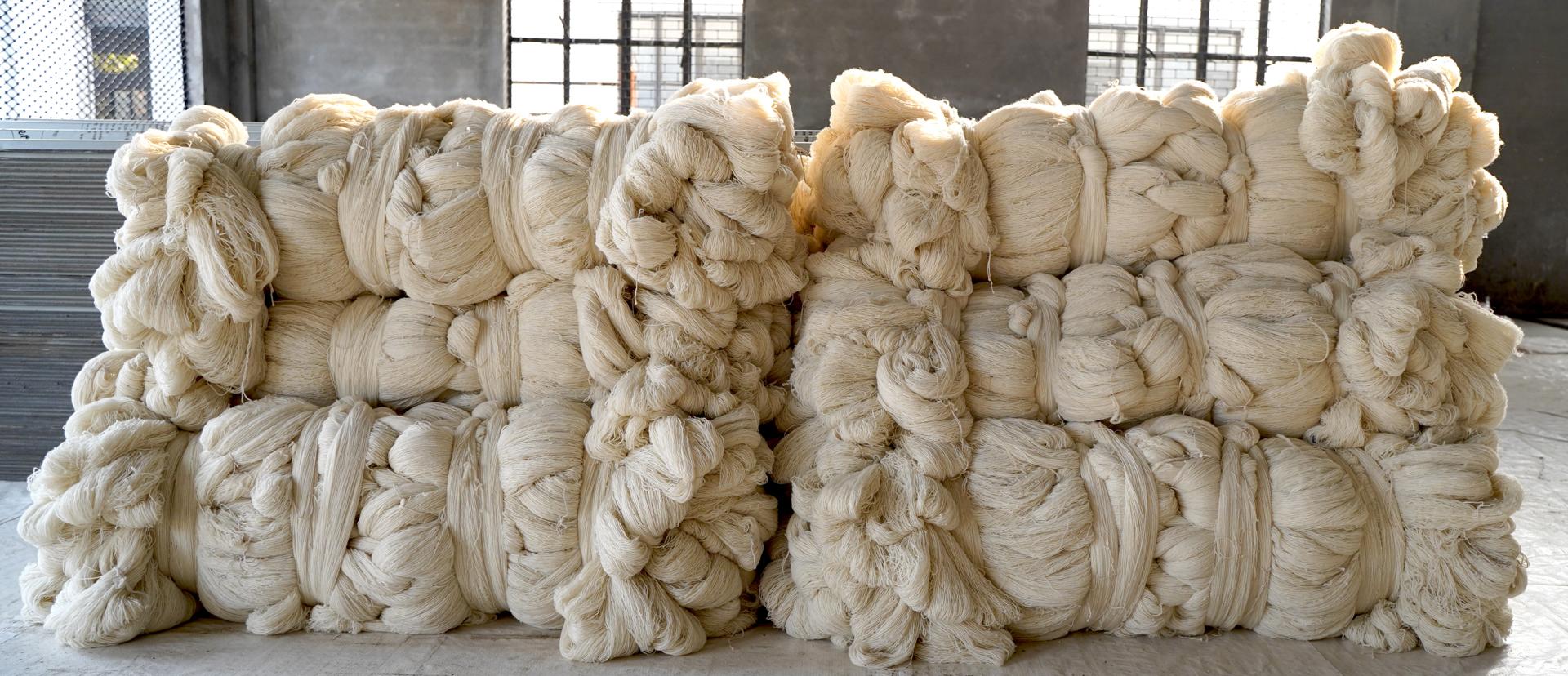
New Zealand wool is widely specified for hotel rugs because it is typically long, strong, white and clean, which spins into a resilient yarn that dyes to clear colours and sheds less. Blends with other wools or with accent fibres adjust cost, texture and lustre, and they work well when the ratio and its purpose are written into the specification and repeated on every reorder.
What makes New Zealand wool suited to rugs
Most New Zealand wool used in rugs comes from crossbred sheep, not from the fine merino used in clothing. Crossbred wool is coarser, and for a rug that is an advantage: a coarser, springier fibre stands up in the pile, recovers after crushing and resists wear. The qualities that matter to a rug maker are these.
- Length. Longer fibres spin into a stronger yarn with fewer loose ends, which means less shedding.
- Whiteness and brightness. A clean, white base lets the dyer reach pale shades and clear colours without the dull cast that a yellower wool gives.
- Bulk and resilience. The fibre fills the pile and springs back, which keeps the surface even under foot.
- Consistency. Wool sold through a well organised supply chain arrives graded and clean, which makes the yarn easier to repeat.
New Zealand wool is not a single grade. It covers a range of qualities, and the yarn a spinner makes from it depends on the lots chosen and the way they are blended, carded and spun.
What Indian and other wools bring
Indian wool is used widely in rugs made in India. It is often more variable in colour and texture than New Zealand wool, and it can give a drier, more rustic hand. That variation is useful in textured and natural looking qualities, where a slightly irregular yarn reads as character. It is also generally lower in cost.
Blending New Zealand wool with Indian wool is a common way to set a balance between clarity of colour, texture and price. More New Zealand content gives a cleaner, brighter yarn. More Indian content gives more texture and a lower cost.
Common blends in hotel rugs
| Blend | What it gives | Where it suits |
|---|---|---|
| 100 percent New Zealand wool | Clear colour, resilience, even surface | Lobby and lounge rugs, premium guestroom rugs |
| New Zealand and Indian wool | Balanced cost, more texture | Large guestroom programmes, textured qualities |
| Wool with silk accents | Lustre and fine detail in selected areas | Suites and feature rugs |
| Wool with viscose accents | Sheen at a lower cost than silk | Accents in low traffic rugs |
| Wool in natural undyed shades | Natural colour, no dyeing | Calm, tonal schemes |
| Wool and nylon | Added abrasion resistance | Mainly machine made broadloom rather than handmade rugs |
Three ways to blend
Fibres can be combined at three points, and each gives a different result.
- In the fibre, before spinning. Two wools, or wool and another fibre, are mixed and carded together. The yarn has an even, often slightly heathered look, and the ratio is fixed by the spinner.
- In the yarn, by plying. Separate yarns are twisted together, which gives a more visible tweed or marl effect.
- In the design. Separate yarns are used in separate areas of the rug, such as a wool ground with viscose in the motifs. The surface shows each fibre clearly.
When a manufacturer spins its own yarn, it sets the blend ratio, the twist and the yarn count itself and can repeat them for a reorder. When yarn is bought in, the blend is whatever the yarn supplier makes that season.
Keeping a long programme consistent
Wool is a natural product, and each season's clip varies a little. A hotel group rolling out one rug design over several properties, or a property ordering replacements years later, needs the yarn to stay the same. The ways to manage that are practical ones.
- Record the full yarn specification at approval: fibre content, blend ratio, yarn count and twist.
- Keep the approved strike off as the physical standard, and a cut of the yarn alongside it.
- Order attic stock from the same production lot as the main order.
- Ask the manufacturer how it blends fibre lots to keep the yarn even from season to season.
Writing the fibre content into the specification
- State the pile composition by percentage, for example 80 percent New Zealand wool and 20 percent Indian wool.
- State the foundation and backing materials separately from the pile.
- Name accent fibres and the approximate share of the surface they cover.
- Only make an origin claim, such as New Zealand wool, if the supplier can document it.
- Check fibre labelling rules for the market where the rugs will be installed or sold, because they differ.
- If a certified claim is wanted, such as responsible wool, decide at the start. Certified claims need certified material through every stage of the chain and the matching transaction certificates.
How Eastern Mills fits
Eastern Mills spins and dyes its yarn in house in Bhadohi, India, where it has made rugs since 1947. Its spinning plant sets the blend for each quality, so a project can specify a wool blend developed for its rugs rather than choosing from stock yarns. The company holds Responsible Wool Standard certification, alongside ISO 9001:2015, GoodWeave, Sedex, GOTS, GRS, SA8000 and C-TPAT. Blends are approved on a strike off, typically 18 x 18 inches, before production of hand tufted hotel rugs or other custom rugs.
Frequently asked questions
Is New Zealand wool softer than Indian wool?
Softness depends on the fibre lots chosen and the way the yarn is spun and finished, not only on origin. New Zealand wool is generally whiter and more consistent, and Indian wool generally has more texture.
Does a blend mean a lower quality rug?
No. A blend is a design decision. A well made blend of New Zealand and Indian wool can perform well in a guestroom and give a texture that pure New Zealand wool does not.
Will a New Zealand wool rug shed?
Some loose fibre comes out of any new wool rug in the first weeks of use. A yarn spun from long fibre with enough twist sheds less, and shedding reduces with regular vacuuming.
Can a hotel project use certified responsible wool?
Yes, if it is planned from the start. Eastern Mills holds Responsible Wool Standard certification. Certified material has to be sourced for the order and documented through the chain, so name the requirement in the brief.


